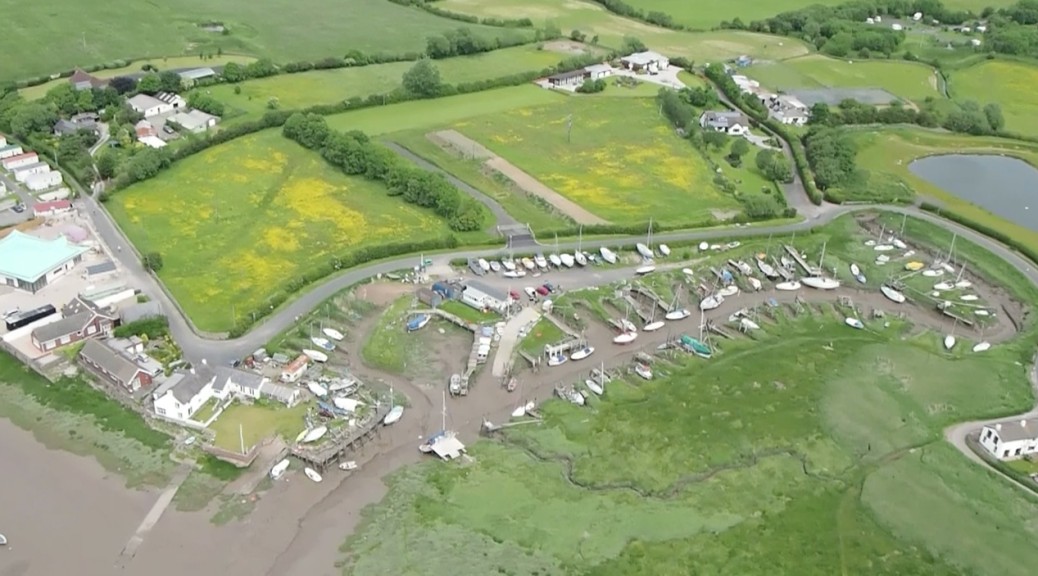
In the summer of 2018, three WMYC sailors go for a sail up to Whitehaven. Please sit back and enjoy the video slide show. Do click full screen if you can.
Hope you enjoyed the ride!

In the summer of 2018, three WMYC sailors go for a sail up to Whitehaven. Please sit back and enjoy the video slide show. Do click full screen if you can.
Hope you enjoyed the ride!
This post constitutes a refresher session on classic sails and rig configuration, there’s plenty of pictures and videos further on, but first an extract from a book called The Sailmaker’s Apprentice to set the tone: –
SEE HOW SHE SCHOONS! Cutting a feather in
a four-lower breeze, sails filling in powerful
curves and pulling like the muscles of a draft horse
with a heavy load; sails straining under the relent-
less force of the wind! By moonrise, the wind’s diminished to a
whisper—hardly a ripple on the water as she
ghosts slowly along under light sails; great cloth
phantoms tranquilly billowing in the moonlight.
Or in an oily calm, the limp cloth slats and slams
from side to side, awaiting the day when it might
explode from its boltropes under the force of a
howling gale and be lashed and beaten to useless
shreds. Harmony and discord in the marriage of
wind, wave, wood, and cloth.
A few weeks ago, on Saturday afternoon a group of Wardley’s sailors were sat happily in the lounge area of the club house talking boats as usual. The conversation turned to sails and rig configuration. We started to talk about gaffs and gunters, and lugsails, topsails, skyscrapers, real canvas, and the days before the utilitarian convenience of plastic sails and aluminium masts. It was a lovely conversation that went on for some time while outside the light faded as the tide slowly ebbed from the creek, and the only thing missing was a nice glass of whisky in hand. We’ve got to admit though, although we all roughly knew what we were talking about — we certainly all had wonderfully romantic images of brightly varnished spars hauling red coloured cotton sails high aloft, ropes smelling of tar leading down to banks of belaying pins and the like — it would be fair to say that we DIDN’T really know our gunters, from our dipping lugs!
Having just recently swotted up on the matter, I thought to try and address these evidently grey areas.
You’ll get refresher on: –
1. Square Rig
2. The Dipping Lug Rig
3. Balanced Lug Rig
4. Standing Lug
5. The Gunter Rig
Ok, let’s go.
1. Square Rig
An ancient sail and most effective on big ocean going sailing ships. Mast stepped centrally. A wooden ‘Yard’ up top. Sail cut square. No boom down below (loose footed). Equal sail for and aft of mast. Powerful on broad reach and off the wind, jibing not a worry. The square Rig. Can be a bugger to tack. (see the video)
As said above, square riggers are a bugger to tack, take a look at the Star of India trying. As you will see its not a walk in the park. Built in Ramsay IoM back in 1853. Now thousands of miles away based in San Diego (USA). The oldest working square rigger on the planet.
2. The Dipping Lug Rig
A variation of the square rig. A very powerful and effective arrangement on all points of sail. The best up wind of all the Lugsails. A bugger to tack though, having to drop the sail and re-hoist on new tack. With a central mast, a long gaff up top, and a loose footed below. The sail’s tack fix-sheeted well forward of mast. Can have a split configuration on the same gaff see the second boat in the image.
2. The Balanced Lug
Mast forward of centre plate, Gaff hoisted up top and pulled close to mast, and peaked high abaft. Sail laced on boom at bottom (can just be held at the tack and clew). Boom tied down by tack down haul to foot of mast. Sail cut out-of-square to accommodate the peak-gaff. Sail laced to gaff. (Junk rig is a fully battened variation.)
Two cracking little balanced lug tender dinghies. They’re probably more fun than their mother ships.
4. Standing Lug
Mast up forward of centre plate. High peaked gaff hoisted up mast. Loose footed, or a boom, at foot. Sail laced on gaff. Tack retained at foot of mast. The ‘Drascombe Dabber’ is an example with a loose footed main sail.
5. The Gunter Rig
This is the most common one you will see. The gaff is held to the mast by jaws at the bottom, and by the halyard keeping it almost vertical at the top. At the bottom of the mast can have a boom or it can be loose footed.
Now, the ultimate gunter sailing dinghy of all time must be the Mirror Dinghy. I learnt to sail in one and I’m certainly not the only one to have done so.
I hope you enjoyed this post. Over the coming week I’ll try to extend this post to include the more modern arrangements commonly use by Wardley’s sailors.
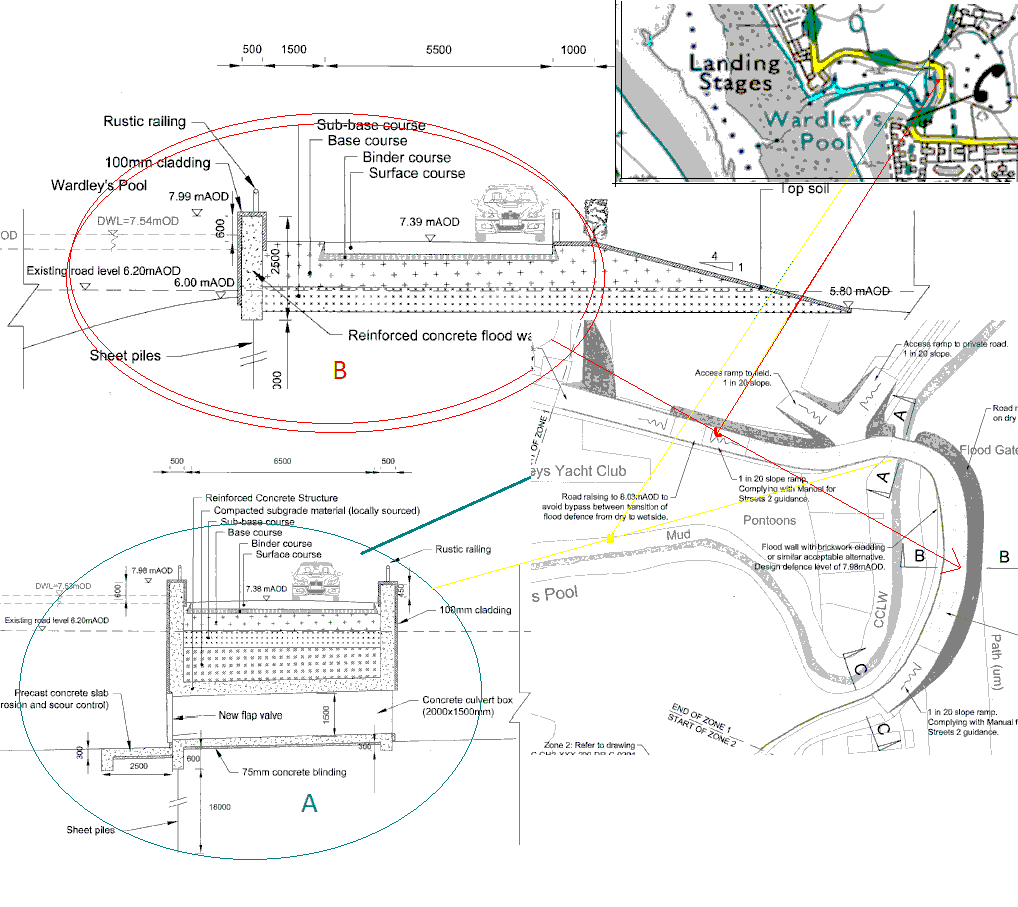
The Environment Agency has unveiled plans for extensive works adjacent to the club, designed to reduce the risk of flooding in the area. In a nutshell, this involves raising the level of Kiln Lane by over a metre between the phone box and the club gate, and continuing with a wall between Shore Road and the marsh, southwards in the direction of Shard Bridge.
Possible negative effects are:-
Apparently the plans have generated some opposition among local residents, and a meeting has been called, at Hambleton Village Hall on Thursday 29th November at 7pm.
A flurry of texts were sent out mid week. The usual sailors were up for an over night cruise to Piel. The weather was generally dull and uninspiring, where the wind didn’t blow hard enough to sail until the final hours on Sunday afternoon. A guest sailor from Leigh & Lowton Sailing Club crewed on Jamila. A good weekend was had all by all.
In early April an assortment of Wardleys sailors crowded around a small map on the club house notice board and chattered excitedly amongst themselves. The map showed a large bay facing the north-east with a thin strip of land separating it from yet another bay of equal size on the opposite side. To the east of these conjoined bays was a thin strip of land, containing a golf-course, jutting out into the Irish sea. Tom, one of the club’s experienced sea-sailors, clutching a large mug of tea, suggested that this would be the ideal place for a ‘Wardleys flotilla’ to rendezvous, after setting out from the tidal channels of Morecambe Bay. Five Wardleys’ skippers declared they were up for the challenge!

Any anchorage had to be well sheltered from the prevailing south-westerlies, and not-least be somewhere on IOM, so a quick straw vote was taken and ‘DERBY HAVEN’ bay it was to be.

Well, as we all know, great plans are easier to make than to realize. Beers in the club house, a good bit of banter alloyed with collective desire for adventure can easily give birth to plans, but somewhere between making and executing plans things can happen. But hey-ho, a month later two Wardleys boats and three members found themselves sailing with the ebb down the river Wyre, stocked up with provisions, diesel, and sails aloft.
Simon was on ‘Jamila’ and Darren and Phil on ‘Rivendell’. The plan was to complete the outward bound cruise in two legs. First to head over to Piel — not that far in the scheme of things — get an early dinner, drink a pint or two, and be sleeping by ten o’clock so ready for a half-past three morning departure.
The other skippers in the planned cruise, Nick, Malcolm and Tom, all hoped break their shackles and rendezvous later on in the week.
For ‘Rivendell’ and ‘Jamila’, the first leg went pretty much according to plan. The two Wardleys boats arrived at Piel in unadulterated sunshine. The scene was the classic ‘summer holiday’. Crowds of tourists, sailors and campers milled around the Ship Inn. Children were crabbing in the shallows.

The Piel ferry was at the slipway full of punters with happy smiles, climbing on and off over the gunwales. Up on the island by the Ship Inn the sounds of joking and laughter, mothers calling children, and dogs barking, all came floating down over the water as far as the two Wardley’s boats now sat at anchor.
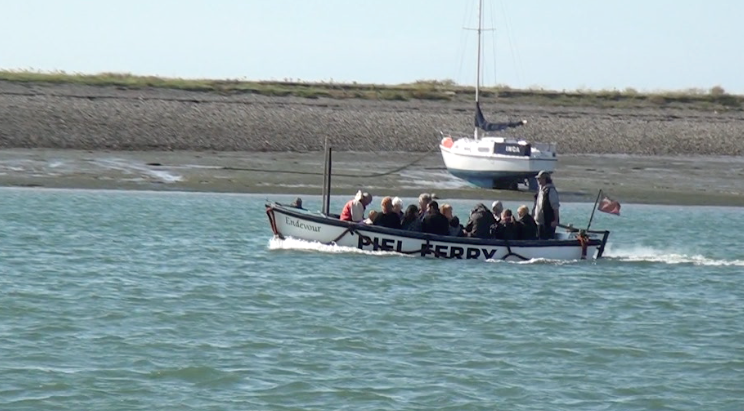
The three sailors decided to wait an hour for the hustle and bustle to clear, then launch the dinghy, go ashore, dine quietly in the Ship, then retire early in preparation for the early start. In fact, all three sailor fell asleep for a short while!
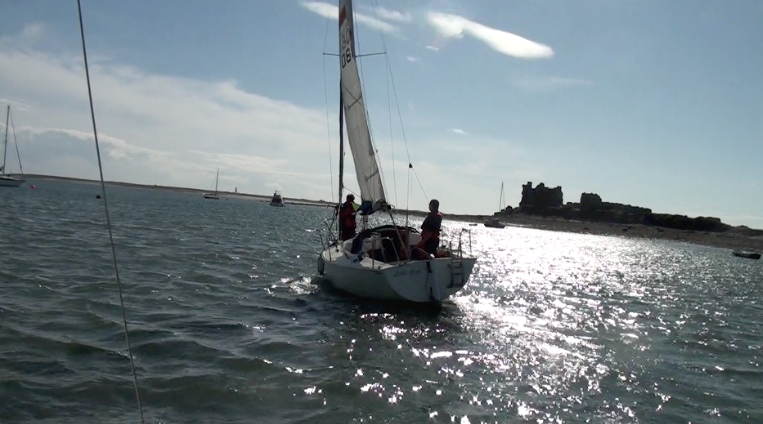
The three sailors packed tightly into Rivendell’s small dinghy to go ashore. As they rowed towards the long pier they could just and so hear, over the rhythmic creaky clattering of the oars, the faint sound of the ‘put, put, put’ sound from the last Piel Ferry heading into the distance depositing the last of the Island visitors on the main land.
A disappointment was awaiting the three sailors!
The walk up the slipway to the Ship Inn was eerily quiet. The landlord’s 4×4, wasn’t in its usual position adjacent to the kitchen, and looking in through the windows, chairs could be seen upside down on every table. The pub was shut! The transition from ‘busy’ to ‘dead’ had happened so quickly. Well, it was Sunday evening, the landlord had some urgent business to conclude in Barrow, and had to leave quick whilst the tidal path across the sand was passable
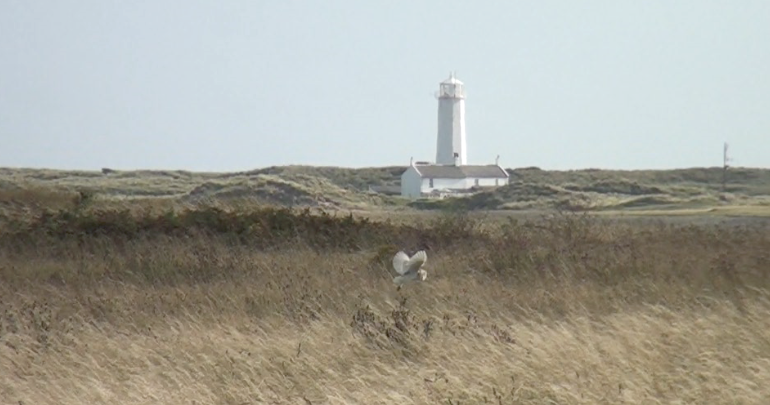
A rather forlorn walk around the island ensued. The evening was idyllic, the views over Morecambe Bay were magnificent but there was a sense of loss and disappointment in the air.
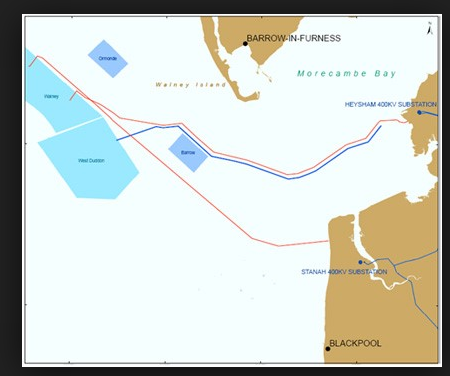
The Wardleys sailors retired back to the boats and set about choosing a route over to ‘Derbyhaven Bay’. After some discussion, a decision was taken on which way to go around the huge wind farm just off Walney Island. One route looked marginally better for the tides, the other route looked better for the winds. A priority was set on sailing and so they selected the southern-route and maybe make a small saving in diesel along the way.
The march of time never stops, dates, deadlines and everything else in life sooner-or-later comes along whether you want it or not. Morning wake-up alarms rang on both boats at half-past three. Luckily, ‘Rivendell’ crew member Phil, a good solid early riser, was on hand to ensured that his skipper ‘Darren’, who’s solidity here is highly questionable, was up and ready by four o’clock, the allotted time for departure. Simon on ‘Jamila’ also made it out of his bunk, and both boats quietly slipped anchor as scheduled. The sun was still more than six degrees below the horizon, just behind the seaside resort of Morecambe, thus the sky was still a dark shade of black. An early morning dog walker, looking out to sea, would have witnessed the dimly lit sails of two vessels quietly tacking down the Barrow channel out into nothingness.
The first part of the long road to IOM was easy, the helmsman maintains a steady path between the red and green channel lights until reaching the ‘Lighting Knoll’ buoy. This last is the main cardinal that marks the start of deep water ahead. During this first leg the sun, still hidden below the horizon, entered the sub six degree sector and the sky started to lighten dramatically. The far-distant shore lights that could be seen all around started to disappear one-by-one and were replaced by thin faint strips of coastline. By the time the two boats arrived at the ‘Lightning Knoll’ buoy a magnificent sunrise over the Northwest coast of England took place. Now…, without doubt, there is no better place to witness this thrilling moment than out at sea.
Over to the west and through the semi daylight gloom a forest of wind-generators started to appear. The first ‘wind-mills’ people see from the shore are just a small farm twenty to thirty strong, but behind those, are three much larger farms that reach-out deep into the Irish sea. Here there are hundreds of them!
The question on the mind of one of the Wardleys skippers was: “Do I go all the way around to the south, or do I cut through the farm and set a heading direct for Derby Haven bay?” By now, the wind was blowing nicely on the beam, perfect for a fast reach all the way to the Isle of Man. The question quickly became, “Should I?”
During this decision making process, the skipper of ‘Jamila’ was looking at the big arrow on his GPS. It was pointing confidently across the Irish Sea towards Derby Haven bay some 50 miles distance.
[It was back in nineteen-seventy-eight that our Americans cousins launched the first of the thirty-three satellites that give us this marvellous navigational aid — god bless Uncle Sam!]
Quite suddenly a corridor opened up in the grid type arrangement of generators and the said GPS arrow was pointing straight down the middle. The corridor looked clearly defined as far as the eye could see, help by the closed-up elignment of the towers on each flank.
Why not?
In an instant Jamila’s tiller was pushed hard to port, her sheets were slackened, her sails allowed to billow, and away she went diving directly into the vast mechanical forest.
The skipper of ‘Rivendel’ decided to stick to the original plan and head for the GPS way-points that had been discussed the night before on Piel Island. This meant a couple more hours of arduous motor-sailing into the wind and tide in order to skirt the southern edge of the wind-farms. This wasn’t really a problem though, for ‘Rivendell’ is a Mirage 2700 equipped with a powerful diesel, and with her big blue spray hood pulled up, she makes a comfortable motorboat when the conditions require. ‘Rivendel’s dividend was paid in FULL two or three hours later. By then she had passed the planned GPS way-point, she was well to the south of the wind farm, she was able to change course to west-north-west bringing the wind onto the beam thus providing the optimum angle of attack, but most importantly, the tide had turned in her favour. All the key parameters had come into alignment. Now, it was full speed ahead for Derbyhaven Bay.
But things got even better!
Suddenly ‘Rivendell’ wasn’t alone, but surrounded by dolphins. A whole pod of them for a period of thirty-minutes headed in the same direction. It is often said that this particular experience can stir and prick the emotions of the hardiest mariners, Daren and Phil can confirm this!
Further to the north ‘Jamila’ was struggling! Advancing beyond the the wind-farms seemed like a losing battle. The south-westerly force-four winds didn’t really materialize as promised. For far too long she was surrounded by them and they just wouldn’t go away. This was largely due to plugging a flood tide still heading towards Morecambe Bay. And in addition, it was all too easy to get complacent whilst relying on the tiller pilot. On more than one occasion the skipper set a course down a corridor of towers only to find, when emerging from the cabin after say doing a spot of chart-work, a blooming great tower reaching high out of the sea, well above the mast and sails, and only yards distance.
The hours passed by. Then three positive events came into conjunction. The tide turned, the wind increased, and Jamila had finally passed the last of the wind-farm generators. Until this point there was still two-thirds of the total distance to sail and four hours had passed by. The GPS was predicting a ETA of eleven o’clock in the evening. It was not a very nice thought, arriving in a strange location late at night in the pitch-black, dropping a hook and hoping for a good night’s sleep. Four more hours passed, during which time Jamila steadily creamed across the Irish Sea, the sky was blue, her white sails pressed hard, and the water around her turned a deeper blue with the odd white crest here and there as the wind steadily increased. Nothing much changed visually until you look behind and traced your eye back along Jamila’s foaming wake to where the wind-farm had been, for now it was but a thin strip of gleaming pins just visible on the horizon.
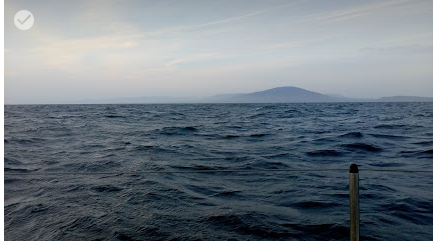
More time passed and still no sign of anything. Its often when you stop straining your eyes looking for something that the something in question comes into sight. Shrouded in mist that is often the case for the Isle of Man the land became visible. Amazing when the Skipper next looked at his GPS the ETA had reduced to seven o’clock in the evening. The combination of the increase in speed and an ebbing tide carrying the boat directly toward ‘Derbyhaven Bay’ had been astonishingly beneficial. The pubs might be still open!
In the meantime Daren and Phil on ‘Rivendell’ were taking the more southerly route around the farms. With the wind more or less on the nose she had gunned past the wind-farms under engine and made much better time. By the time the favourable beam wind had arrived, she was more than an hour ahead, and had disappeared out of sight of ‘Jamila’. In the end both boats arrived safely and dropped their anchors, still in bright daylight.
As it happen, visits to pubs was far from what the Wardleys’ sailors really desired. What they all really really wanted was sleep and lots of it!
The delights of Derbyhaven, and Castletown just beyond, would be checked-out in the morning.
As for the other Wardleys sailors who had been huddled around the club notice board back in April, Nick arrived a day or two later, Malcolm arrived a week later, and Tom’s dreams of a late May IOM adventure were spoilt by unexpected commitments.
There’s more to come soon: “The middle of the night gale in Derbyhaven Bay”